
- Major ActivitiesMajor ActivitiesThe Northeast Asian History
Foundation is the center of
Northeast Asian history research - ResourcesResourcesThe Northeast Asian History
Foundation is the center of
Northeast Asian history research - NewsNewsThe Northeast Asian History
Foundation is the center of
Northeast Asian history research - IntroductionIntroductionThe Northeast Asian History
Foundation is the center of
Northeast Asian history research
-
Screen size
-

- Major Activities
- Resources
- News
- Introduction
- Website Guide
Resources
Publication
- Date 2010.08.26
- Hit 5307
1. All rights of the contents and the electronic files in the Webpage are reserved for the Northeast Asia History Foundation.
2. No part of the Webpage may be reproduced, stored in retrieval system, or transmitted, in any form or by any means, without the prior permission.
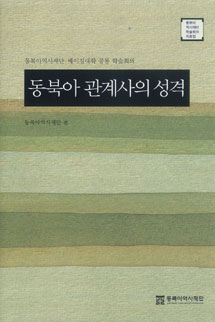
Title: (Northeast Asian History Foundation Conference Proceedings) Characteristics of Northeast Asian Relations
Northeast Asian History Foundation (Ed.)
Northeast Asian History FoundationㅣNew A5 Editionㅣ415 pagesㅣ15,000 wonㅣAugust 14, 2009
ISBN 978-89-6187-126-6-94900
978-89-6187-128-0-94900 (set)
The title is a collection of research papers presented at the conference co-hosted by the Northeast Asian History Foundation and China’s Beijing University. The research projects were organized to narrow the gap between Korea and China’s perception of their shared history. The papers cover Korea and China’s perceptions of each other and also detail era-by-era characteristics of Korea-China relations spanning the Three Kingdoms Period, Goryeo dynasty, Joseon dynasty, and all the way up to the 20th century. This endeavor at tracing the history of Korea-China relations will contribute to the understanding of what is happening in Northeast Asia today.
Table of Contents
• Worldview Underlying ‘Accounts of Eastern Barbarians’ in “Book of Wei” of Records of Three Kingdoms / Jeong Ha-hyeon
1. Foreword
2. Ancient China’s foreign relations and Korean academia’s approach to the topic
3. Organization of the “Treatise on Geography” of Han Shu and the Chinese worldview during the Han dynasty
4. Narrative stance and viewpoint of ‘Accounts of Eastern Barbarians’ in “Book of Wei” I: Issues concerning geographical outlook
5. Narrative stance and viewpoint of ‘Accounts of Eastern Barbarians’ in “Book of Wei” II: Aiming for a Chinese world
6. Conclusion
• Inner Asian Origin of Goguryeo’s Law Enforcement Posts / Luo Xin
1. Origin and succession of Gorgueyo’s law enforcement posts
2. Inner Asian origin of the etymology of “加”
3. Background behind Tuoba Xianbei and other Inner Asian peoples’ adoption of aka/akan as government titles
4. Conclusion
• Battle of Baek River and Changes in Northeast Asian Relations / Kim Hyeon-gu
1. Foreword
2. Formation of the Silla-Tang-Japan trilateral alliance
3. Formation of the configuration of the Battle of Baek River
4. Changes in Northeast Asian intraregional relations
5. Conclusion
• Tombs of Princess Jeonghye and Princess Jeonghyo in Light of the Funerary Style of the Tang Dynasty / Li Zhisheng
1. Burial Goods(陪葬) of the tombs of Princess Jeonghye and Princess Jeonghyo
2. Concerning the placement of Princess Jeonghyo’s burial chamber
3. Further comments
• Characteristics of the History of Goryeo’s Relations with Liao, Jin, and Yuan Dynasties / Kim Dang-taek
1. Foreword
2. Goryeo and Liao
3. Goryeo and Jin
4. Goryeo and Yuan
5. Conclusion
• Goryeo Families in the Eight Banners of Manchu and War in the Early Qing Dynasty / Xu Kai
1. Inclusion of Goryeo 43 Province families into the Eight Banners of Manchu
2. Independently organized the Company(佐領) of Joseon and Goryeo
3. Goryeo families and war in the early Qing dynasty
• From Joseon’s Sincocentrism to the Korea-Qing Treaty: Establishment of Modern Korea-China Relations / Lee Tae-jin
1. Foreword
2. Ming-Joseon investiture & tributary system
3. 18th-century Sinocentrism of Joseon and inferiority shock
4. Conflicts concerning the investiture & tributary system in the 1880s and the conclusion of the Korea-Qing Treaty in 1899
5. Conclusion
• Comments on the Characteristics and Impact of Zhizheng Tiaoge / Dang Baohai
1. Relationship between Zhizheng Tiaoge and Tongzhi Tiaoge
2. Development of the legal concept of the Yuan dynasty
3. Zhizheng Tiaoge’s impact on East Asia
4. Conclusion
• Korea and China’s Early 20th-century Perceptions of Each Other: Centering on Sun Yat-sen’s Perception of Korea and Koreans’ Understanding of Sun Yat-sen / Bae Gyeong-han
1. Foreword
2. Exchanges between Sun Yat-sen and Koreans
3. Sun Yat-sen’s stance on the Korea issue
4. Koreans’ understanding of Sun Yat-sen
5. Conclusion
• Ideals and Realities of the Changes in Modern Korea-China Relations: Historical Origin of Koreans’ Negative Perception of the Chinese /Wang Yuanzhou
1. Foreword
2. From the “call to conquer the north” to the “northern view of history”
3. From Muhua(慕華) to Jianhua(賤華)
4. Conclusion: Historical memory, national psychology, and international outlook
